
From a moment in a classroom to a decision that changes it.
- 01 — 02
- Capture and connect the signal
- 03 — 04
- Understand and model the pattern
- 05
- Act, with the decision left to people
- 06
- Learn, and return to the beginning
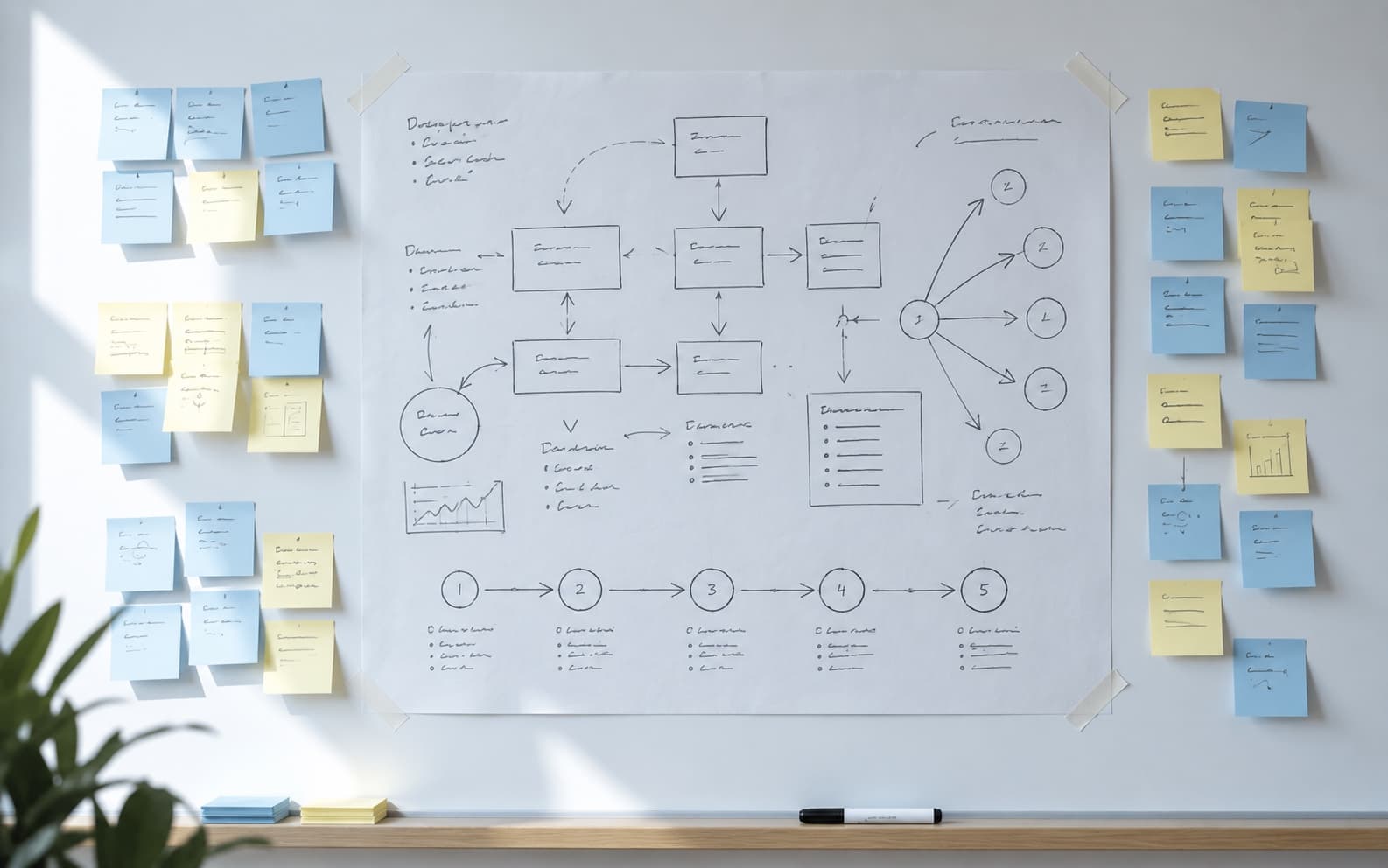
Six steps, one continuous movement.
Described separately, these read like stages in a pipeline. In practice they overlap continuously: signals are being captured while earlier signals are being modeled, and outcomes from last term are already reshaping what the system understands about this one.
The best intelligence doesn't interrupt the experience.
- 01
Capture
Simple interactions gather meaningful signals without disrupting learning.
Prompts are placed where an answer is actually knowable — at the moment a concept lands, or fails to. Participation costs a few seconds and produces something structurally useful: a state, a concept, a timestamp, a context.
- No surveys, no separate workflow, no added administrative burden
- Every signal is anchored to a concept, a moment, and an environment
- Participation is visible to the participant and never silent
- 02
Connect
Signals connect with context, activity, historical behavior, and institutional data.
Alone, a comprehension signal is an opinion. Joined to attendance, submissions, curriculum sequence, advising history, and prior outcomes, it becomes evidence. Artifact begins by connecting to the systems an institution already runs: nothing has to migrate, and every existing system keeps operating. Where an institution later chooses to consolidate, capabilities can move into Artifact over time.
- Connects to the SIS, LMS, and data warehouse — no migration to begin
- Identity and access governed by institutional policy
- Purpose limitation enforced in the schema, not only in policy
- 03
Understand
Patterns begin revealing how learning and behavior relate to outcomes.
With enough connected signal, relationships surface: which conditions precede recovery, which precede disengagement, where understanding reliably forms, and where a curriculum sequence consistently produces friction.
- Relationships examined at concept, course, cohort, and program scale
- Findings are explainable — a person can ask why and get an answer
- Disparate impact tested continuously rather than assumed away
- 04
Model
The platform models possible future trajectories and pathways.
From a current state, several trajectories are plausible. Each carries an estimated likelihood, the conditions contributing to it, and the decisions that would measurably shift it. Concepts from decision modeling help identify which of those decisions carry the most leverage.
- Pathways, not verdicts — a set of possibilities with their conditions
- Surfaced early enough that an intervention can still change the outcome
- Evaluated on whether flagged trajectories improved, not on accuracy alone
- 05
Act
People receive intelligence they can use to make better decisions.
The same intelligence is expressed differently for each person who can act on it — because a student, a professor, and an advisor are each making a different decision. The system informs. The person decides.
- Delivered where the decision is already being made
- Expressed in the vocabulary of teaching and advising
- No consequential action is ever taken by the system alone
STUDENTA concept worth revisiting this weekPROFESSORWhere the cohort lost the threadADVISORA conversation worth having earlyThe same underlying intelligence, expressed three different ways — because three different decisions are being made.
- 06
Learn
The system continuously learns from outcomes, creating an evolving intelligence loop.
What actually happened returns to the system as evidence. Over successive cycles, the intelligence layer becomes more specific to the institution that produced it — which is the point. A model of learning at one university should not be a model of learning everywhere.
- Outcomes feed back as evidence, not just as records
- The intelligence layer becomes more institution-specific over time
- Assumptions are re-examined as the environment changes
Experience, signal, intelligence, prediction, action, outcome.
What this requires of an institution.
- Of students
- A few seconds, a few times a week, inside an environment they are already in.
- Of faculty
- No change to how they teach to begin. Prompts are placed with them, not for them. Where an institution later consolidates, their tools move into one place — not more places.
- Of IT
- To begin, governed read access to existing systems, reviewed on the institution's terms. Any deeper consolidation is a joint architectural decision, made on the institution's timeline.
- Of leadership
- A decision about what the institution actually wants to understand — which is the part that takes the most work.

What would this look like in your environment?
Every institution's version of this sequence looks slightly different. The first conversation is usually about which questions are worth answering.